

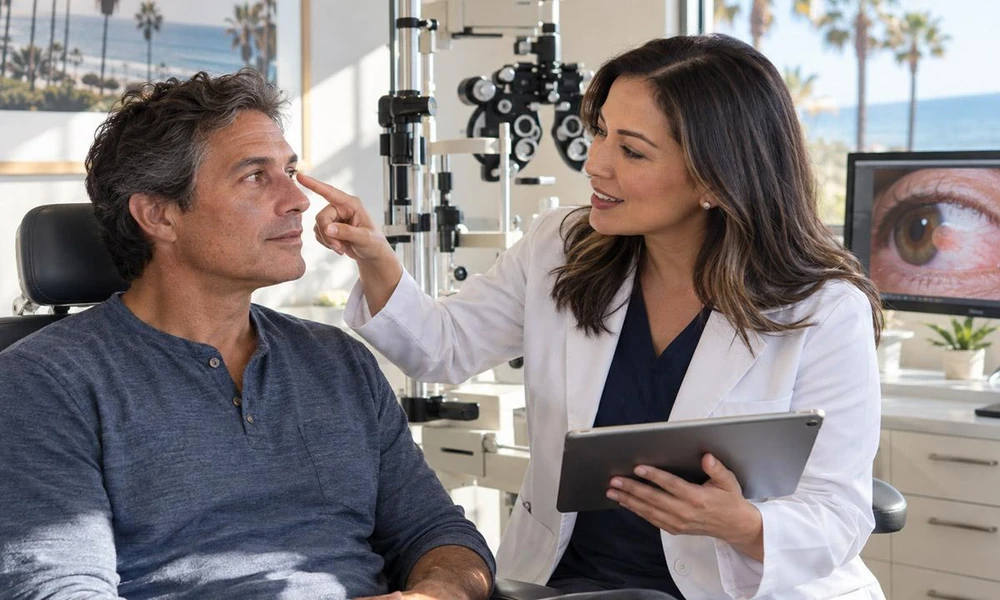
Pterygium, often called surfer’s eye, is a fleshy, noncancerous growth on the white of the eye that can extend onto the cornea. It is strongly linked to years of UV exposure, wind, dust, and dry air, which makes Southern California’s sunny outdoor lifestyle a real risk. Mild cases are often managed with eye drops, and surgery with a tissue graft greatly lowers the chance of regrowth. UV-blocking sunglasses and hats are the best prevention.
Pterygium is most common in a band of the globe that stretches about 37 degrees north and south of the equator, and all of Southern California sits inside it. That geography helps explain why pterygium in Southern California is far from a rare curiosity. In July 2021, the National Weather Service forecast a UV index of 11 for the entire region, warning that fair skin could burn in under five minutes.
The nickname “surfer’s eye” suggests it belongs to people who spend mornings in the water off Huntington Beach. In Orange County, that picture is far too narrow. Golfers, hikers, gardeners, construction crews, and parents who spend entire weekends at sunny ballfields collect the same UV exposure, often without a thought for their eyes.
Why Southern California Sits Inside the “Pterygium Belt”
Pterygium is most common in sunny regions within about 37 degrees of the equator, an area often called the pterygium belt. Orange County sits at roughly 34 degrees north, with strong sunshine for much of the year, so UV exposure builds up quickly for anyone who spends significant time outdoors.
According to StatPearls, reported pterygium rates vary widely around the world, from about 0.3% to 29% depending on the population studied. A 2013 meta-analysis in BMJ Open that pooled 20 studies found the condition was generally more common at lower latitudes. In other words, living closer to the equator tends to mean more UV exposure over a lifetime.
For perspective, that forecast of 11 is well past 8, where the EPA’s UV Index scale calls for extra protection. Our marine layer can be misleading, too: May Gray and June Gloom mornings feel mild, but the American Academy of Ophthalmology (AAO) notes that UV rays pass through haze and thin clouds.
What a Pterygium Is, and How It Differs From a Pinguecula
A pterygium is a wedge-shaped growth of fleshy tissue with blood vessels. It starts on the conjunctiva, the clear membrane covering the white of the eye, usually on the side nearest the nose, and it can extend onto the cornea. A pinguecula is a yellowish, raised bump that stays on the white of the eye.
The AAO describes both growths as likely caused by UV light, wind, and dust. They’re also related: the AAO’s six things to know about these conditions explain that a pinguecula can sometimes become a pterygium, and it notes the nicknames “surfer’s eye” and “farmer’s eye.” StatPearls adds that a pinguecula often causes no symptoms at all.
Both growths are noncancerous. Still, other conditions on the surface of the eye can look similar, so any new or changing growth deserves a professional exam rather than a guess in the bathroom mirror.
How the SoCal Outdoor Lifestyle Adds Up
Pterygium isn’t caused by one bad sunburn or a single windy afternoon. The risk builds over years. The BMJ Open analysis linked higher rates to more outdoor sun exposure, male sex, and rural living, with rates climbing as people age, and EyeWiki, the AAO’s clinical encyclopedia, lists UV radiation, dry climates, and outdoor lifestyles among the main risk factors.
Consider an ordinary Orange County week: sunlight bouncing off sand and water at the beach, all-day youth soccer and baseball tournaments, weekend hikes in the Santa Ana Mountains or Chino Hills, and early tee times that stretch past noon. For people who work construction, tend grounds, or staff outdoor venues, those hours happen five days a week.
Then there are the Santa Ana winds. Researchers describe them as dry offshore winds that bring low humidity to the coast, and StatPearls lists hot, dry weather, wind, and dust among pterygium risk factors. No study shows that Santa Ana causes pterygium, but a gusty Santa Ana day adds dryness and airborne irritants on top of the sun.
The AAO points out that surfers, fishermen, skiers, and farmers face especially intense UV near water and in the mountains. If you spend your mornings in the ocean, our guide for surfers covers sport-specific advice.
Symptoms That Deserve an Eye Exam
Many small pterygia cause few or no symptoms. When they do, people often notice redness, irritation, tearing, or a gritty feeling like something is stuck in the eye. A pterygium that grows onto the cornea can change its shape and blur vision, which is one reason monitoring matters.
As a pterygium pulls on the cornea, it can create astigmatism, an irregular curve that makes vision blurry or distorted. In more advanced cases, the growth can extend across the cornea toward the center of your vision.
An eye doctor typically confirms the diagnosis with a slit-lamp exam, a close look using a specialized microscope, and may track the growth’s size over time. Consider scheduling a visit if you notice a growth on the white of your eye, if it seems to be getting larger, or if irritation or blurry vision doesn’t settle down.
Pterygium Treatment, From Soothing Drops to Surgery With a Tissue Graft
Mild pterygia are usually managed with lubricating eye drops and, during flare-ups, short courses of prescription anti-inflammatory drops. Surgery is considered when the growth affects vision, keeps growing, or causes ongoing discomfort. Modern surgery removes the growth and covers the area with a thin tissue graft to lower the chance of regrowth.
Managing Symptoms Without Surgery
The AAO and EyeWiki describe lubricating drops and ointments for irritation, plus short courses of prescription steroid drops to calm redness and swelling, used only under a doctor’s direction. These options can make eyes more comfortable, but they don’t remove the growth. For more detail, see our article on managing pterygium without surgery.
Why the Graft Matters
According to EyeWiki, surgery generally enters the conversation when a pterygium blurs vision, induces astigmatism, keeps growing, limits eye movement, or causes irritation that drops don’t relieve. Older surgery simply removed the growth and left the white of the eye bare. This bare sclera excision had high regrowth rates: StatPearls reports recurrence from 24% to 89%, and EyeWiki cites rates as high as 80%.
Today, many surgeons consider the conjunctival autograft the gold standard. The surgeon takes a small piece of healthy conjunctiva from the same eye, usually from under the upper eyelid, and uses it to cover the area where the growth was removed. EyeWiki cites a recurrence of roughly 5% to 10% with this technique, while StatPearls notes a broader range of about 5% to 31% across studies.
An AAO technology assessment of 51 randomized trials found that both conjunctival grafts and mitomycin C, a medication some surgeons apply during surgery, reduced recurrence compared with bare sclera removal, and that conjunctival grafts outperformed amniotic membrane grafts. Mitomycin C carries its own risks, including thinning or breakdown of the white part of the eye. A later review of 20 randomized trials found conjunctival grafts lowered the six-month risk of regrowth by about 47% compared with amniotic membrane.
“How a pterygium is removed matters as much as removing it, because the graft helps keep it from returning.”
Fibrin Glue Instead of Stitches
StatPearls reports that securing the graft with fibrin glue offers better comfort after surgery than stitches. Pterygium surgery at Anaheim Eye Institute uses natural fibrin glue instead of traditional stitches to secure the graft, and Dr. M. Reza Neal, a fellowship-trained surgeon, specializes in the procedure.
Anaheim Eye Institute reports recurrence rates of less than 2.5% with this approach. That is a practice-reported figure, and published studies show the wider ranges described above. Your surgeon will explain what recovery looks like for your eye.
Preventing Pterygium in Southern California, From Beaches to Ballfields
Because UV exposure is the main known risk factor, sun protection is the most practical step. The AAO recommends sunglasses labeled 100% UV protection or UV absorption up to 400nm, ideally in oversized or wraparound styles that limit light from the sides. Polarization by itself doesn’t provide UV protection.
Add a broad-brimmed hat whenever you’re outside, even on gray mornings. The EPA also suggests seeking shade from late morning through mid-afternoon when UV is elevated.
On dusty or windy days, including Santa Ana conditions, the AAO recommends protecting your eyes from dust with glasses or goggles and using artificial tears for dryness. Getting kids used to sunglasses and hats at the beach or ballfield builds habits that last.
Protection matters after surgery, too. The AAO notes that regrowth is more likely in people under 40, and EyeWiki reports that about 97% of recurrences happen within the first year, so UV protection and follow-up visits stay important. A routine eye exam helps keep watch on any growth that is changing or blurring your vision.
Enjoy the Southern California Sun With Healthier Eyes
Living in the pterygium belt makes surfer’s eye a concern for everyone in Orange County. The encouraging part is that UV-blocking sunglasses and a broad-brimmed hat reduce exposure to the main known risk factor, and modern graft surgery has made regrowth far less common than it once was.
If you’ve noticed a growth on your eye, or one that seems to be changing, an exam is the right next step.
Have questions about your vision or are you ready to explore your options? The team at Anaheim Eye Institute has been helping Orange County patients see clearly since 1958.
Book an Appointment or call 714.533.2020.
Medical disclaimer: This article is for informational purposes only and is not a substitute for professional medical advice, diagnosis, or treatment. Growths on the eye can have different causes, so please consult your eye doctor about any changes in your eyes or vision.
Frequently Asked Questions
Is pterygium the same as surfer’s eye, and do you have to surf to get it?
Yes, “surfer’s eye” is a common nickname for pterygium, which is also sometimes called “farmer’s eye.” You don’t have to surf to develop one. Years of exposure to UV light, wind, and dust raise the risk, especially in sunny places like Southern California.
What’s the difference between a pterygium and a pinguecula?
A pinguecula is a yellowish, raised bump on the white of the eye that does not extend onto the cornea. A pterygium is a fleshy growth with blood vessels that can extend onto the cornea and sometimes affect vision. A pinguecula can occasionally develop into a pterygium, so any new or changing growth should be evaluated.
Can a pterygium go away on its own?
A pterygium does not typically go away on its own. Lubricating drops and short courses of prescription anti-inflammatory drops can ease symptoms but don’t remove the growth. Surgery removes it and is usually considered when the growth affects vision, keeps growing, or causes persistent discomfort.
Will a pterygium come back after surgery?
Recurrence depends heavily on surgical technique. Older bare sclera removal had regrowth rates as high as 89% in some studies, while a conjunctival graft lowers recurrence substantially, with many reports around 5% to 10%. Anaheim Eye Institute reports recurrence rates of less than 2.5% with its graft and fibrin glue technique, and ongoing UV protection after surgery remains important.
What sunglasses are best for preventing pterygium?
The American Academy of Ophthalmology recommends sunglasses labeled 100% UV protection or UV absorption up to 400 nm. Wraparound frames help block light from the sides, and polarization alone does not protect against UV. A broad-brimmed hat adds further protection.
